59% of gaming IAP revenue comes from paid installs; non-gaming subscription flips to 70% organic
15% of non-gaming apps monetize through subscriptions
9.84% of non-gaming installers convert to buyers; gaming payers show a tighter repeat rate
Introduction
Mobile monetization has never been a single story. Subscription revenue is growing at multiples of what ad-based models produce. Hybrid monetization is expanding across formats that once relied on a single stream. The line between gaming and non-gaming economics is blurring as each vertical borrows mechanics from the other.
What has not changed is the fundamental question every developer and marketer faces: how do you build a revenue model that holds up beyond the install? Acquiring users has always been the first problem. Monetizing them efficiently — converting the right users at the right point, retaining their spending over time, and understanding which streams compound — is the challenge that determines whether a business scales or stalls.
This report maps the underlying mechanics of monetization across formats, geographies, and user types: acquisition source, revenue timing, payer behavior, and model mix. The data spans early 2026 and covers the full range of monetization models currently operating at scale in mobile.
* All results are based on fully anonymous and aggregated data. To ensure statistical validity, we follow strict volume thresholds and methodologies and only present data when these conditions are met.
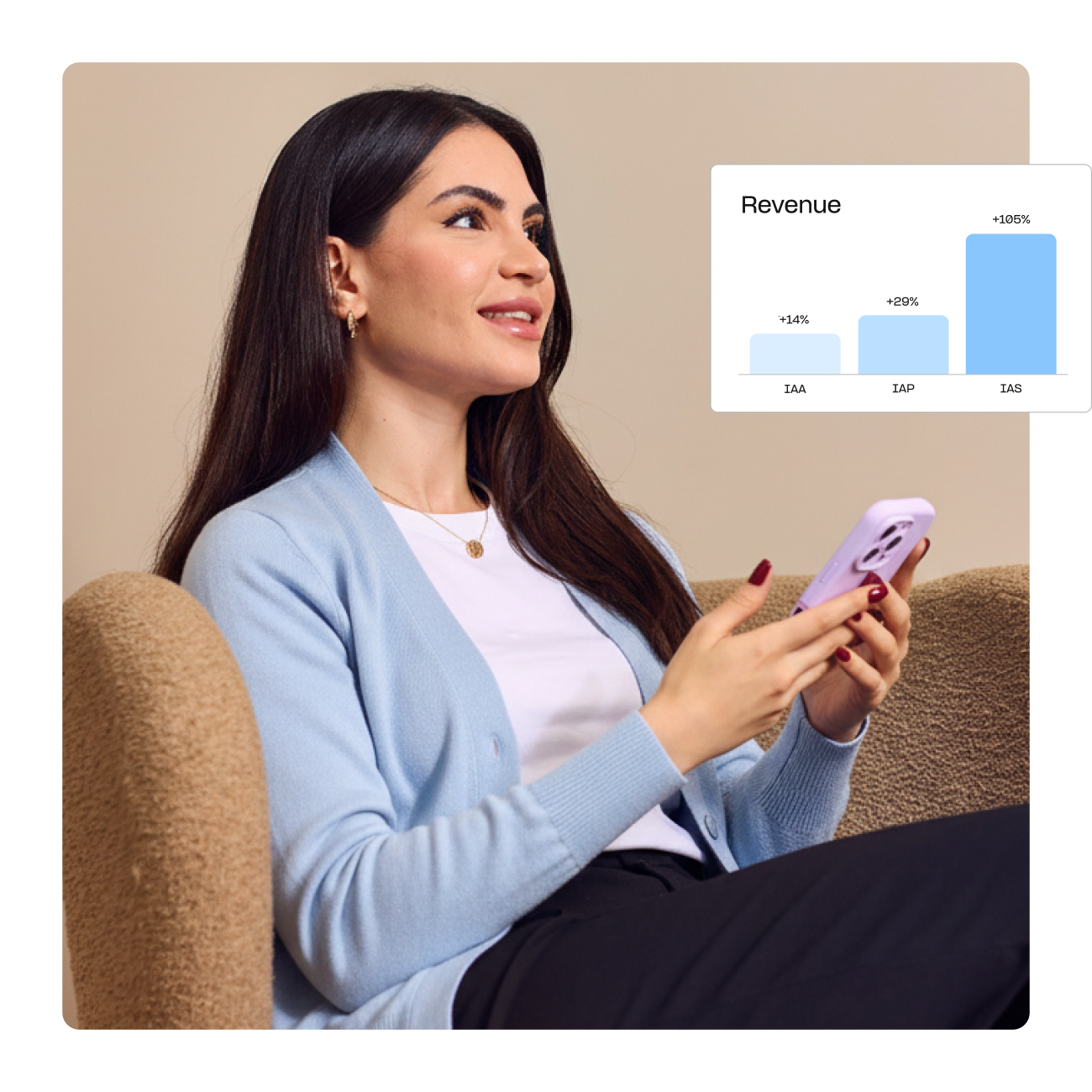
Subscription revenue doubles YoY, outpacing ad and IAP by a wide margin
Subscription revenue processed via the stores grew 105% year-over-year in Q1 2026, the strongest rate across all revenue streams. Ad revenue grew 14% over the same window and store in-app purchase (IAP) revenue grew 29% YoY.
Across the full 15-month period, subscription showed the most consistent upward trajectory of the three, with its monthly share of its own revenue cycle climbing from a low of 4.1% in February 2025 to a peak of 9.7% in January 2026 (+136%) before a modest pullback. Ad revenue’s distribution peaked in December 2025, when it accounted for 7.8% of its total earnings in the measured time frame, then compressed into Q1 2026. IAP followed a broadly similar seasonal pattern, reaching its highest monthly concentration in March 2026 at 8.1%, compared to a low of 5.3% in February 2025.
Those growth rates tell different stories at the advertiser level. Seven in ten advertisers with subscription revenue grew in-app subscription (IAS) revenue year-over-year, the highest account-level growth rate across all three streams and a sign that the aggregate gain reflects genuine breadth. Ad revenue and IAP both cleared a growth majority, at 57% and 53% of active accounts respectively, but the margins are narrow enough to suggest aggregate gains fall unevenly across the cohort.
Among the accounts generating meaningful revenue across all three streams, a cohort that skews heavily toward gaming, subscription’s share of combined revenue nearly doubled over the 15-month period, from approximately 4% in January 2025 to nearly 7% by early 2026. Ad revenue absorbed most of that compression, declining from roughly 63% to approximately 56% of the mix. IAP held broadly flat at around 35%, which may indicate that in-app purchase monetization is relatively stable within these diversified apps while subscription steadily gains ground.
Revenue trend by stream (normalized) *
Share of apps that grew / declined YoY (Q1 2026 vs. Q1 2025) *
Revenue split among apps with all revenue streams *
Day 90 ARPU peaks at $2.43 in Casino, nearly double the Casual average
At Day 90 after install, IAP average revenue per user (ARPU) across gaming categories follows a clear gradient. Casino tops the chart at $2.43 globally, nearly double Casual’s $1.34 and roughly 14% above Midcore’s $2.13. The hierarchy reflects structural differences in how each genre monetizes: casino games attract players with high spending intent, and their core mechanics center on frequent, high-value transactions that compound over the full 90-day window.
Midcore titles generate sustained purchase activity through progression systems and content gating, with players returning repeatedly to invest in their game state. Casual’s lower ARPU reflects a broader and more price-sensitive user base.
In-app advertising (IAA) ARPU adds a complementary dimension, with Casual leading at $0.55 within 90 days of install, followed by Casino at $0.47 and Midcore at $0.40, while Hypercasual’s $0.22 reflects the per-install dilution that comes with the format’s characteristic high install volumes.
At the payer level, the average revenue per paying user (ARPPU) picture narrows the gap between categories. Casino payers spend $11.40 per user within 90 days of install, 57% above Casual’s $7.26 — a smaller differential than the 81% ARPU gap between the same two categories. That compression suggests Casino’s ARPU advantage over Casual reflects higher conversion rates as much as deeper per-user spend.
Midcore sits between the two at $9.80, consistent with a genre that monetizes through sustained engagement. Non-gaming subscription apps generate a comparable $10.85 ARPPU, nearly matching Casino and sitting above Midcore. Subscription apps in health, productivity, and utility categories appear to attract users who commit at a high value point, placing IAS (in-app subscription) monetization on par with the highest-spending gaming genre when measured per payer rather than per install.
In North America & Europe, ARPU runs 20–25% above global across all categories, but the regional premium narrows at the ARPPU level to roughly 5–10%, suggesting that users in tier 1 markets convert more often. The pattern holds across both gaming and non-gaming, pointing to conversion rate as the primary driver of regional ARPU differences rather than spend depth.
IAP Day 90 ARPU *
IAP Day 90 ARPPU *
IAA Day 90 ARPU *
Ad revenue reaches 89% of Day 60 revenue by Day 7 while IAS takes until Day 30
By Day 7, in-app advertising has generated 89% of its full Day 60 total, making it the fastest-maturing revenue stream across all monetization models. IAP reaches 60% of its Day 60 value by the same point, while IAS reaches only 52%. The gap is widest on Day 1: IAA generates 57% of its Day 60 total within the first 24 hours, roughly twice the rate of IAS at 28%.
Ad revenue’s front-loading appears to reflect the shape of mobile retention curves — most ad impressions occur early, when active users are most concentrated, and each subsequent day of churn reduces the earning window. The practical implication for measurement is significant: Day 7 LTV is a reliable proxy for Day 60 IAA performance, but substantially underestimates what IAP and IAS will eventually contribute.
Gaming categories show meaningful variation around this pattern. Hypercasual generates the most front-loaded IAA of any category — 63% on Day 1 — likely a function of the format’s extreme early churn, where many users engage for a single session before leaving.
Casino apps show the most back-loaded IAP curve in the dataset: only 23% of purchase revenue arrives on Day 1, compared to 38% across all apps, suggesting casino players deliberate before spending, which may reflect higher typical purchase values and the exploratory nature of early sessions. Gaming IAS is also notably slower to build than the overall IAS average — 21% on Day 1 versus 28% — pointing to subscriptions in gaming requiring meaningful play experience before users are willing to commit.
Non-gaming IAS follows a less uniform pattern. The aggregate curve averages two distinct monetization approaches: apps that present a subscription paywall at first launch, common in utilities, news, and some health and fitness categories, and apps that offer a free trial before converting. These two models produce very different Day 1 values, and the averaged curve sits between them.
The pattern holds consistently across all five regions in the dataset, which may suggest that revenue accumulation timing is primarily a function of the monetization model itself rather than geography.
Revenue split within 60 days of install (cumulative) *
Paid installs drive most gaming IAP revenue, organic leads non-gaming IAS
Paid installs generate 59% of gaming store IAP revenue overall, compared to just 30% for non-gaming subscription revenue — a gap that sharpens when viewed by gaming category. Hypercasual is the most acquisition-dependent at 79% paid, which reflects the format’s near-zero retention model: with few users returning beyond the first session, continuous paid acquisition is the primary mechanism for driving purchase volume.
Casino sits at 64% paid, consistent with a category where player acquisition is a deliberate investment given high potential lifetime values. Casual follows at 61%, where organic discovery faces one of the most competitive app store verticals. Midcore is the most balanced at 49% paid, which may indicate that the format’s longer engagement cycles allow organic word-of-mouth and search-driven discovery to play a more meaningful role in a community-driven genre where more hardocre gamers exchange views and recommendations.
The regional picture adds a significant dimension. In LATAM, the paid dynamic largely reverses: Casual shifts from 61% paid globally to only 37%, and Midcore moves from a near-even split to 43% paid and 57% organic. A possible explanation is that paid UA investment concentrates in North American and European markets, where most mobile gaming budgets sit, leaving LATAM growth to depend more heavily on organic discovery and app store placement.
Non-gaming subscriptions show a different regional pattern: organic leads in every region, peaking at 80% in MEA and ranging between 69% and 75% elsewhere. LATAM and NA+Europe show the highest paid share for non-gaming IAS at roughly 31%, though organic remains the clear majority in both, suggesting the non-gaming pattern reflects the nature of the revenue model rather than regional market dynamics.
That structural difference likely comes down to how each revenue stream is triggered. Gaming IAP decisions are often more impulsive in nature, made early in a session, which makes paid acquisition a direct driver of transaction volume. Subscription decisions tend to be more deliberate — and non-gaming subscription apps, many of which operate in health, productivity, and utility categories, often carry stronger brand recognition than gaming titles of comparable scale. Users searching for a meditation app or an invoicing tool are more likely to have a specific product in mind before opening the store, which reduces the role of paid acquisition in closing the conversion. The data suggests this dynamic holds consistently across all five regions.
Organic vs. paid revenue split *
Subscriptions reach 15% of non-gaming apps while gaming stays mostly IAP
Among non-gaming apps with active purchase or subscription revenue, 15.6% use subscriptions in some form — 10.2% through IAS exclusively and another 5.4% combining subscriptions with one-time purchases.
This subscription presence is concentrated in categories built around ongoing value delivery: health and fitness, productivity, education, generative AI, and photo and video apps consistently show the highest IAS penetration across the dataset. These apps offer tools and content that users expect to access continuously, which creates a natural fit for the subscription model.
The gaming picture is dominated by IAP and IAA, split sharply by category. Midcore is the most purchase-driven at 90% IAP Only — players invest in progression and content over long engagement cycles that make one-time purchases the natural monetization mechanism.
Hypercasual sits at the opposite extreme at 79% IAA Only, reflecting a model built on volume acquisition and ad impressions rather than player spending. Casual is the most diversified gaming category, splitting across IAP (47%), IAA (28%), and Hybrid (21%) — a profile that reflects the format’s dual appeal to both spenders and non-paying users. Casino lands closest to Midcore at 83% IAP, consistent with its high-value transactional mechanics.
Share of apps’ monetization streams
Non-Gaming converts more installs to buyers while gaming payers repeat More
Non-gaming apps convert 9.84% of installs to one-time buyers and 4.64% to repeat buyers within 30 days — conversion rates that exceed gaming across every category. The ratio between one-time and repeat buyers in non-gaming sits at 2.12x, meaning for roughly every two users who make a first purchase, one goes on to make a second. Gaming’s conversion rates are lower, but the repeat ratios are tighter across categories, pointing to a higher likelihood that a paying gaming user will purchase again.
The structural explanation likely reflects frequency of use: many non-gaming purchases are more one-off by nature while gaming returns users (especially payers who have already engaged with the game in a meaningful way) to the same app daily, creating more natural opportunities for repeat spending.”
Within gaming, Casino converts 4.95% of installs to one-time buyers and 3.01% to repeat buyers, with the tightest ratio in the category at 1.65x. Midcore follows at 1.76x and Casual at 1.89x. The gradient tracks engagement depth: casino mechanics tie purchases to gameplay outcomes at high session frequency, producing a higher likelihood of repeat spending.
Casual’s wider 1.89x ratio reflects a broader user base where purchase intent is more varied. Across all gaming categories, the conversion rate to repeat buyer is consistently lower than non-gaming in absolute terms, but the gap between first and second purchase is narrower — a distinction worth noting when evaluating user quality rather than user volume.
Regionally, one-time buyer conversion rates run from 11.14% in North America to 6.51% in LATAM, and repeat buyer rates from 5.08% to 3.09% across the same range. The one-time to repeat ratio holds at approximately 2.1x in all four regions, suggesting that the likelihood of a second purchase after a first is a behavioral pattern that does not shift meaningfully by market. Conversion rate to first purchase, by contrast, varies by region suggesting a spending power and market maturity dynamic.
Share of paying users by type and category *
Share of paying users by type and region *

Subscription revenue is growing at multiples of IAP and ad revenue, with 71% of subscription-monetizing accounts growing year-over-year. Consider whether your app's core value proposition supports a recurring model, even alongside existing IAP mechanics. The hybrid IAP+IAS combination is gaining ground in categories like Casual gaming, Generative AI, and Health and Fitness.

IAA apps recover nearly 90% of their Day 60 revenue by Day 7, making early LTV a reliable proxy for ad-monetized installs. IAP and IAS build more slowly, with subscriptions reaching only 52% of Day 60 revenue by Day 7. Using a single LTV measurement window across mixed monetization models may systematically undervalue slower-building streams.

70% of non-gaming subscription revenue comes from organic installs, and organic payers show higher per-user revenue than paid in most non-gaming categories. Consider prioritizing brand visibility and app store optimization alongside paid acquisition. The organic advantage in subscription categories may reflect intent-driven discovery that paid channels struggle to replicate at the same efficiency.

Among gaming categories, Casino shows a high share of one-time buyers going on to purchase again. Evaluate post-purchase engagement mechanics that create natural conditions for a second transaction. The pattern is most pronounced in formats with high session frequency, where return visits create structural opportunities for repeat spending.

Hybrid models combining IAP and IAA are expanding across all gaming categories, and Casual already splits across IAP, IAA, and Hybrid streams. Explore whether layering a secondary revenue stream alongside your primary model could add incremental revenue without cannibalizing existing payers. Midcore and Casino remain largely single-stream, which may represent an opportunity worth testing.


